Coinbase's lending app runs on Morpho, but Aave took another route to new users in 2026. Other brands now run their own lending markets on Aave's contracts as well. EtherFi's Cash card, Kraken's Ink chain and the curator Sentora each run an Aave market for their own users, while Aave's hub on Circle's Arc came with a deal that guarantees the DAO a yearly minimum. After EtherFi moved its Cash loans onto an Aave V4 instance from Jul 30, the card brought all of Q3's rise in Aave's monthly users.
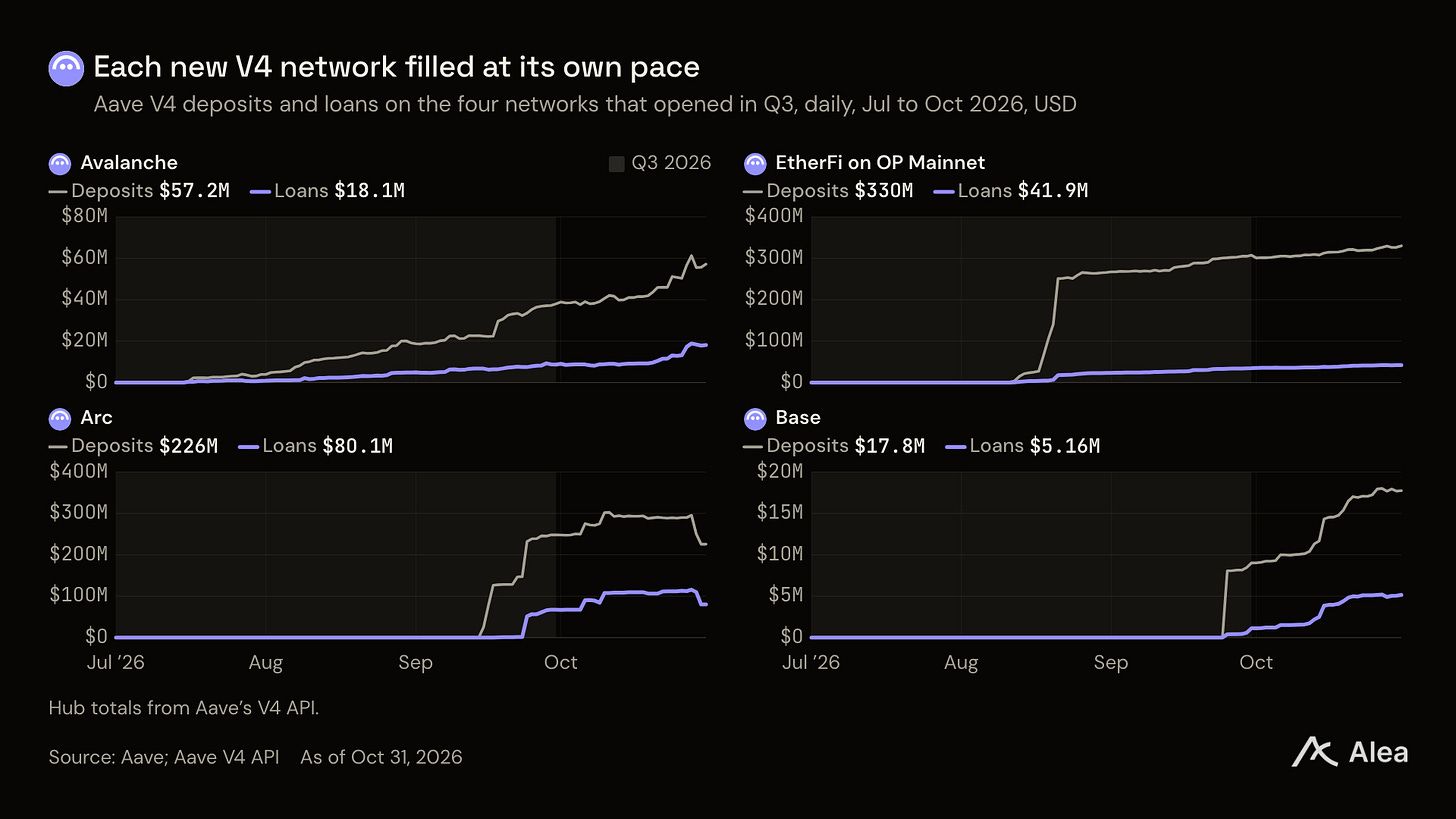
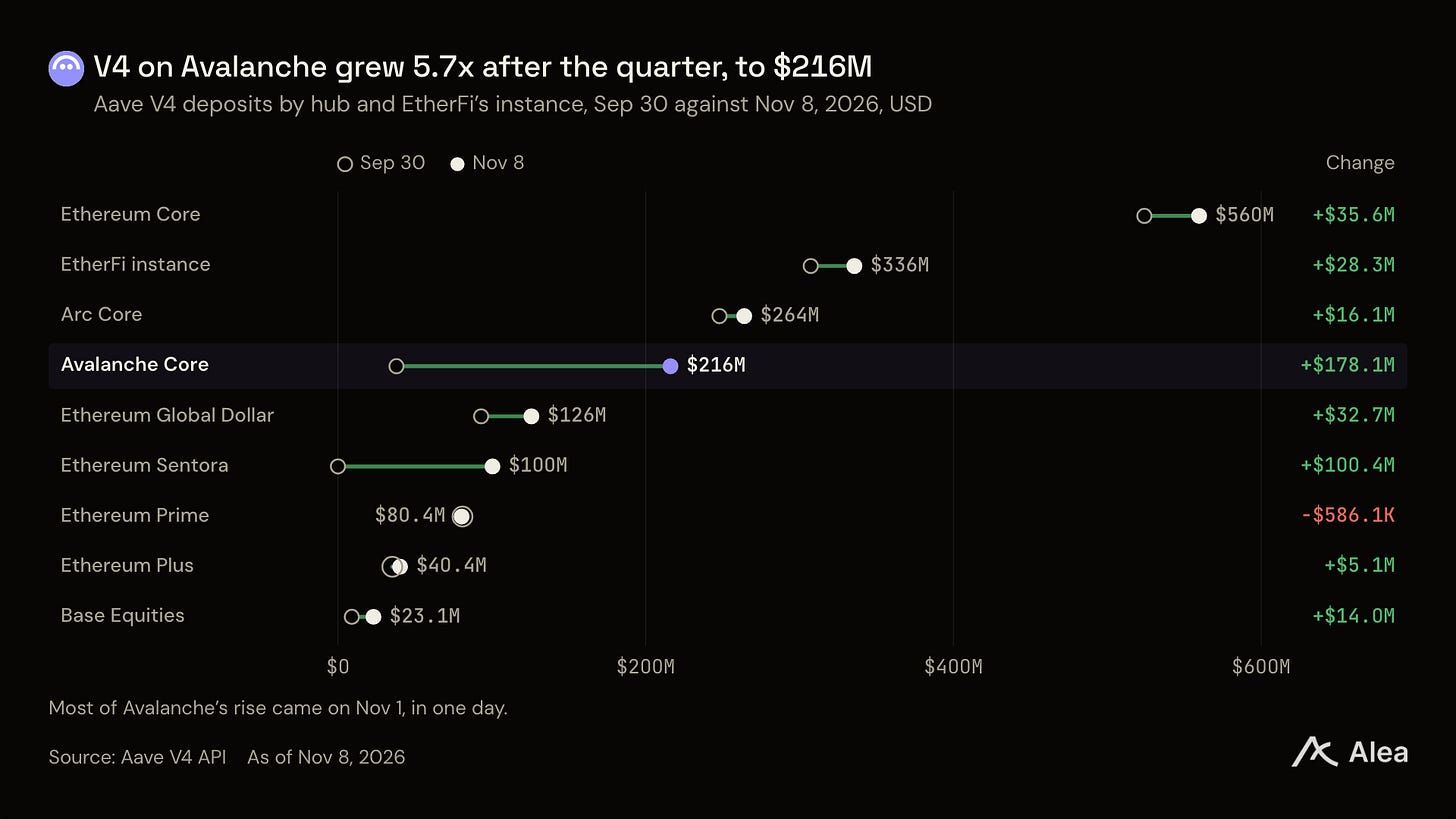
V4 adds hubs for new collateral and partner-run instances. It began Q3 on Ethereum alone and opened on four more networks by Sep 30. Its deposits rose from $230M at Jun 30 to $1.34B at Sep 30, with $307M in EtherFi's instance and $248M in Arc's hub.
Without EtherFi's instance, V4's deposits grew 4.5x. Of V4's $882M of gross Ethereum supply, at least 21% came from addresses that had left V3 Core with the same token the week before, and at least 32% within 92 days. Core still grew. By Nov 8, V4 held $1.75B of deposits and $597M of loans. V3 still earns almost all of Aave's interest, though: in Q3, V4 earned under a fiftieth of V3's $95.4M outside GHO.
Takeaways
Partners now bring their own users to Aave's contracts. EtherFi pays the DAO 20% of its instance's revenue and Sentora 50%, while Arc's deal sets a floor of $2M a year for five years.
V4 deposits rose 5.8x in Q3, to $1.34B, and loans rose from $76M to $403M. Aave's monthly users rose from 89,800 to 148,800.
Aave Core's USDC pool added $326M in Q3 with no rewards. It took $145M after the stewards raised dollar rates on Aug 27, as Core USDT lost $86M; rewarded inflows elsewhere added $1.13B.
Aave's own dollar GHO earns the DAO about 5x what a USDC loan earns per dollar lent, before the DAO pays savers. After the DAO pays GHO savers, GHO roughly broke even in Q3.
DAO revenue passed costs from August; Q3's surplus before staker rewards covers a buyback sized to those rewards. The rsETH deficit is $179M, with about $110M still due from pledges or the DAO.
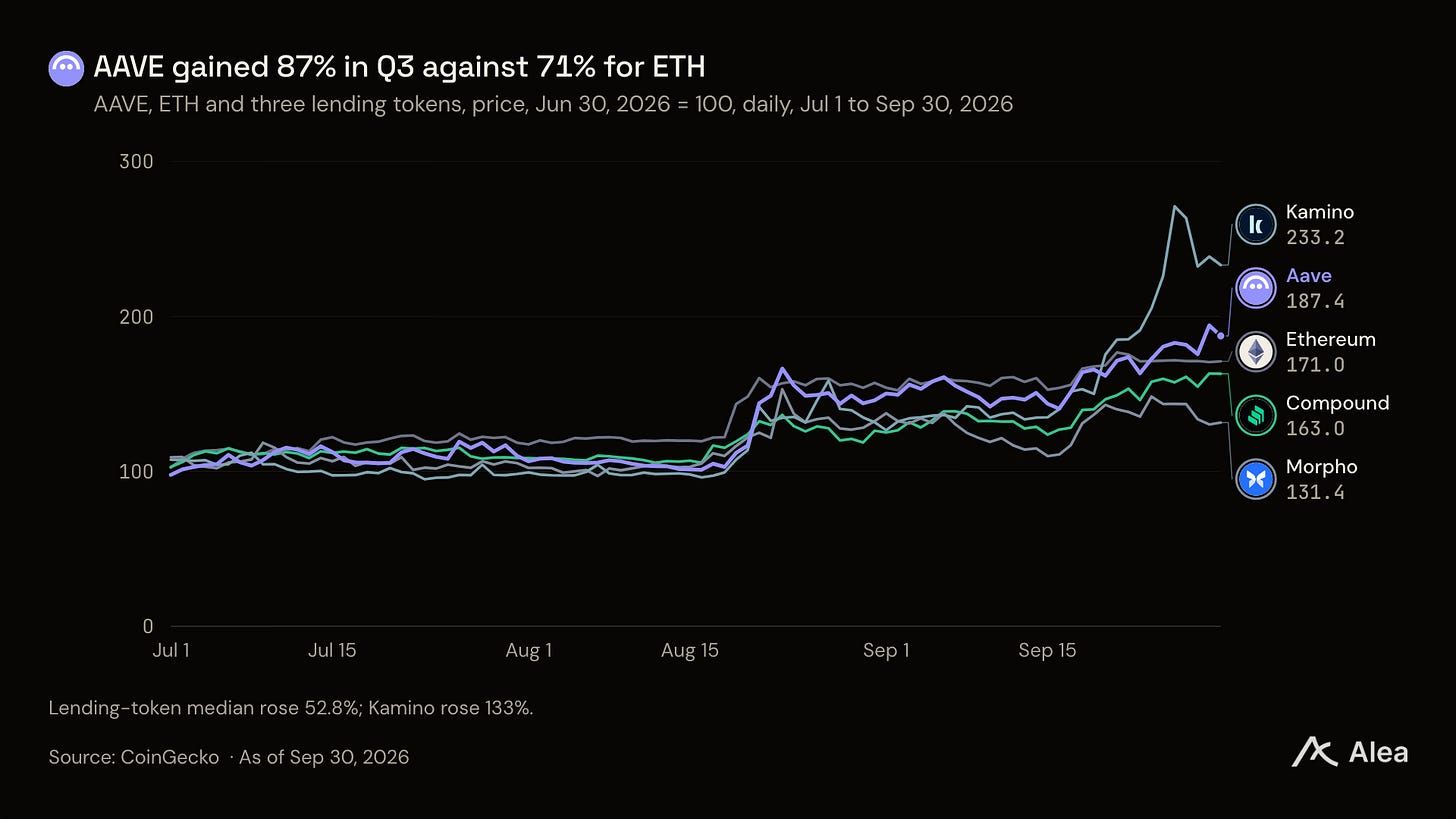
AAVE rose 87.4% in Q3, ahead of ETH's 71.0% and the 52.8% median of the six other lenders' tokens. It closed Nov 8 21.0% below its Sep 30 close.
Partners run their own Aave markets
V4 pools liquidity in hubs and sets risk in spokes: a spoke sets what a borrower can post, and a hub's lenders carry each spoke's bad debt up to its cap. That split lets a partner run its own market on Aave's contracts, with its own collateral rules, and pay the DAO a share of what it earns.
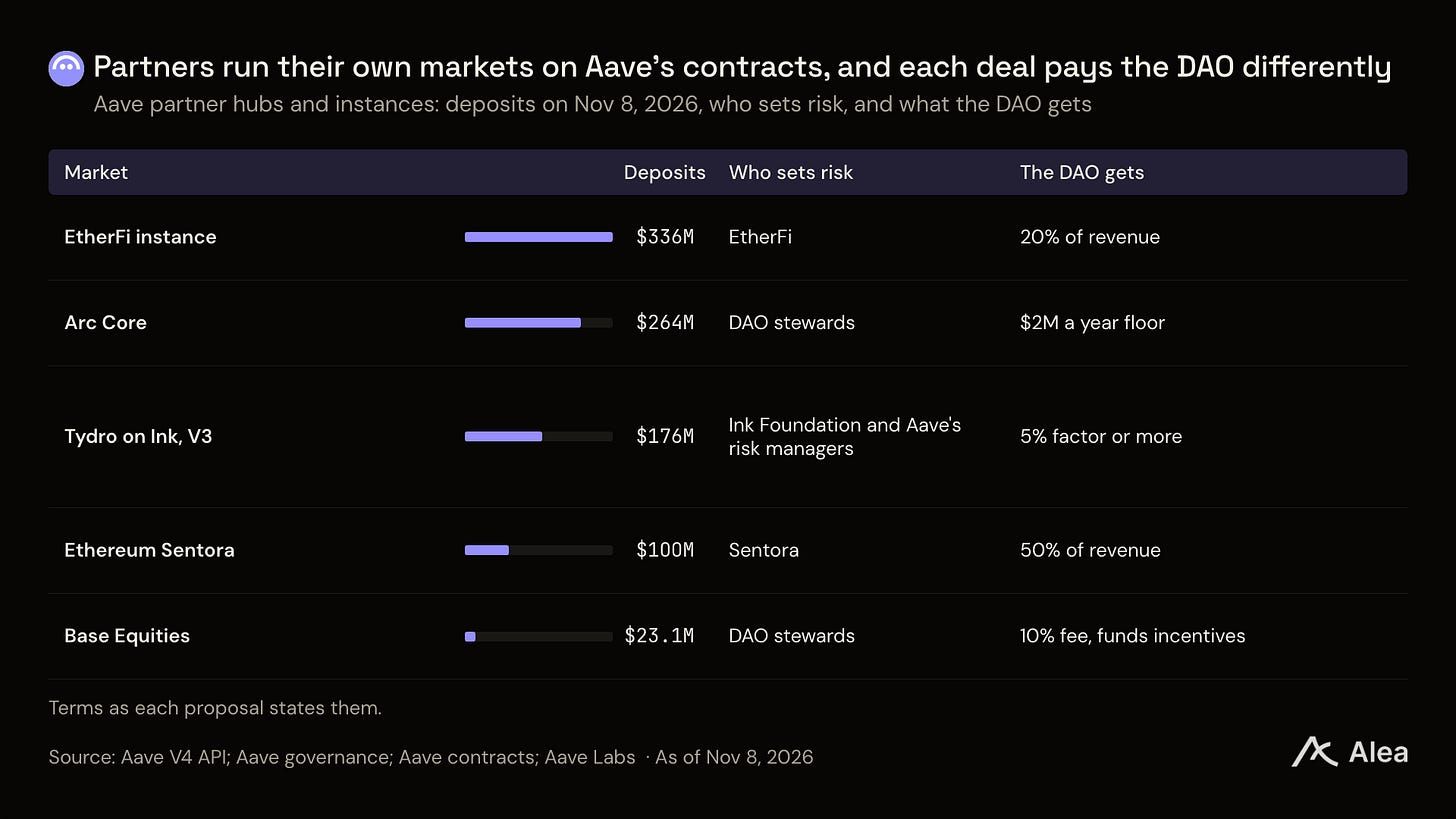
EtherFi runs a whole Aave instance for Borrow Mode on its Cash card and pays the DAO 20% of its revenue, about $1.0M to $1.2M a year at its $500M target. Sentora runs the first hub curated outside the DAO and pays the DAO half of its revenue, though the DAO's own risk providers don't monitor that hub. On Arc, the DAO's own stewards set risk, under a deal the DAO approved with a floor of $2M a year for five years. V3 has partner deals too: Ink Foundation runs Tydro on V3 under a commercial agreement Aave announced, with help from Aave's risk managers. Tydro held $197M at Sep 30.
Partner channels count because Morpho competes for the same deposits: across all chains, Aave's share of the two lenders' combined deposits went from 68.8% at Jun 30 to 66.6% at Sep 30. It fell to 63.9% by Nov 8. After Sep 30, Morpho's largest gain came on Arbitrum, where a Maple loop took its deposits from $23M to $303M by Nov 8.
On Nov 5 Kraken's parent Payward announced that an affiliated fund and Payward's clients had bought AAVE on the secondary market, without naming an amount.
Allocations and rewards moved Q3's dollars; Core's USDC grew without them
Seven lenders compete for the same crypto collateral and stablecoin borrowers. Aave held 50.6% of their deposits at Sep 30, 54.0% of their loans and 49.2% of their Q3 fees. Morpho's share of deposits rose from 23.7% to 25.5% through distribution: Coinbase's lending app on Base, plus a Robinhood Chain market that went from nothing to $1.03B. Spark's share rose from 11.6% to 13.2% on Sky's own dollars and the ETH price. SparkLend runs on Ethereum and Gnosis; its Gnosis market was frozen in January and wound down by the Sep 10 spell, leaving Q3 lending on Ethereum. Both rivals took share mostly from Kamino, Compound, Fluid and Euler.
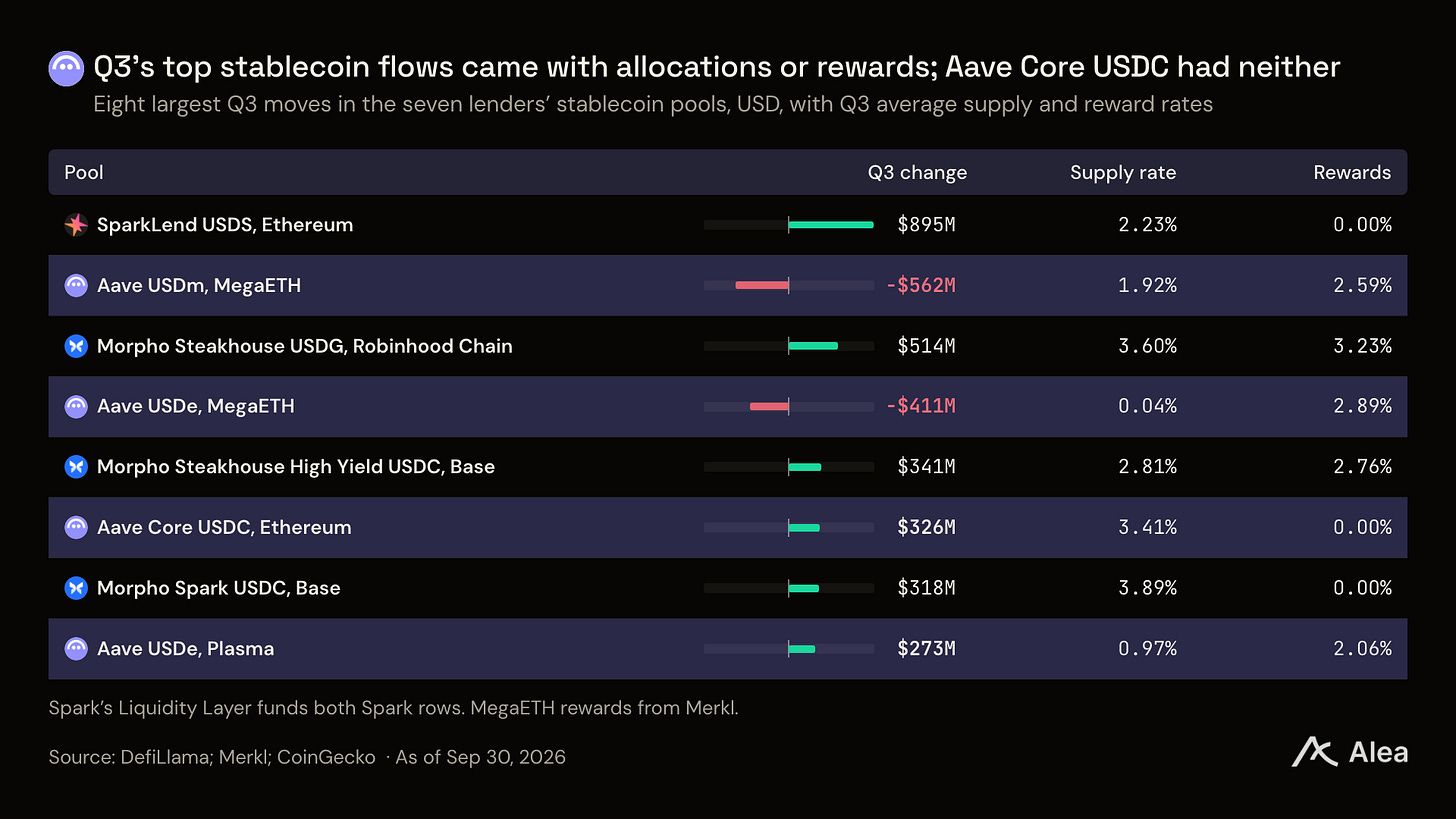
Sky issues the USDS dollar and runs Spark. It moved the most money, almost all of it Sky's own. Spark's Liquidity Layer deploys Sky's dollars. It supplied $845M of the SparkLend USDS pool's $895M rise. It also holds nearly all of two Morpho vaults, Spark USDC on Base and Sentora x Spark RLUSD, which added $568M. The USDS pool gave back $256M by Nov 9. Rewards came next. The three largest rewarded inflows added $1.13B and kept it through Nov 9. Their rewards paid 2.1% to 3.2% on top of their rates. Rewards alone didn't hold MegaETH's two stablecoin pools, which lost $972M in Q3 after Avant Protocol began closing its loop there on Jul 7.
Aave Core's USDC pool grew with no rewards. It added $145M from Aug 30 to Sep 30, after the stewards raised dollar rates on Aug 27. Core USDT lost $86M over the same weeks, which leaves a net gain of $59M across Core's two dollars. After the Oct 29 freeze stopped USDT and USDC from backing new loans, Core USDT lost $230M from Oct 28 to Nov 9, while Core USDC added $483M. Loops follow the spread the stewards set. The staked-ETH loop stays because the stewards hold the WETH rate under the staking yield. When they raised the USDe borrow floor to 6.3%, loans of Ethena's dollar tokens fell $576M in September.
Depositors and liquidators keep 86 cents of each fee dollar
Borrowers paid $99.6M of Q3's $100.5M of fees. Depositors and liquidators kept $86.5M, which left the protocol $13.9M, or 13.8 cents of each fee dollar.
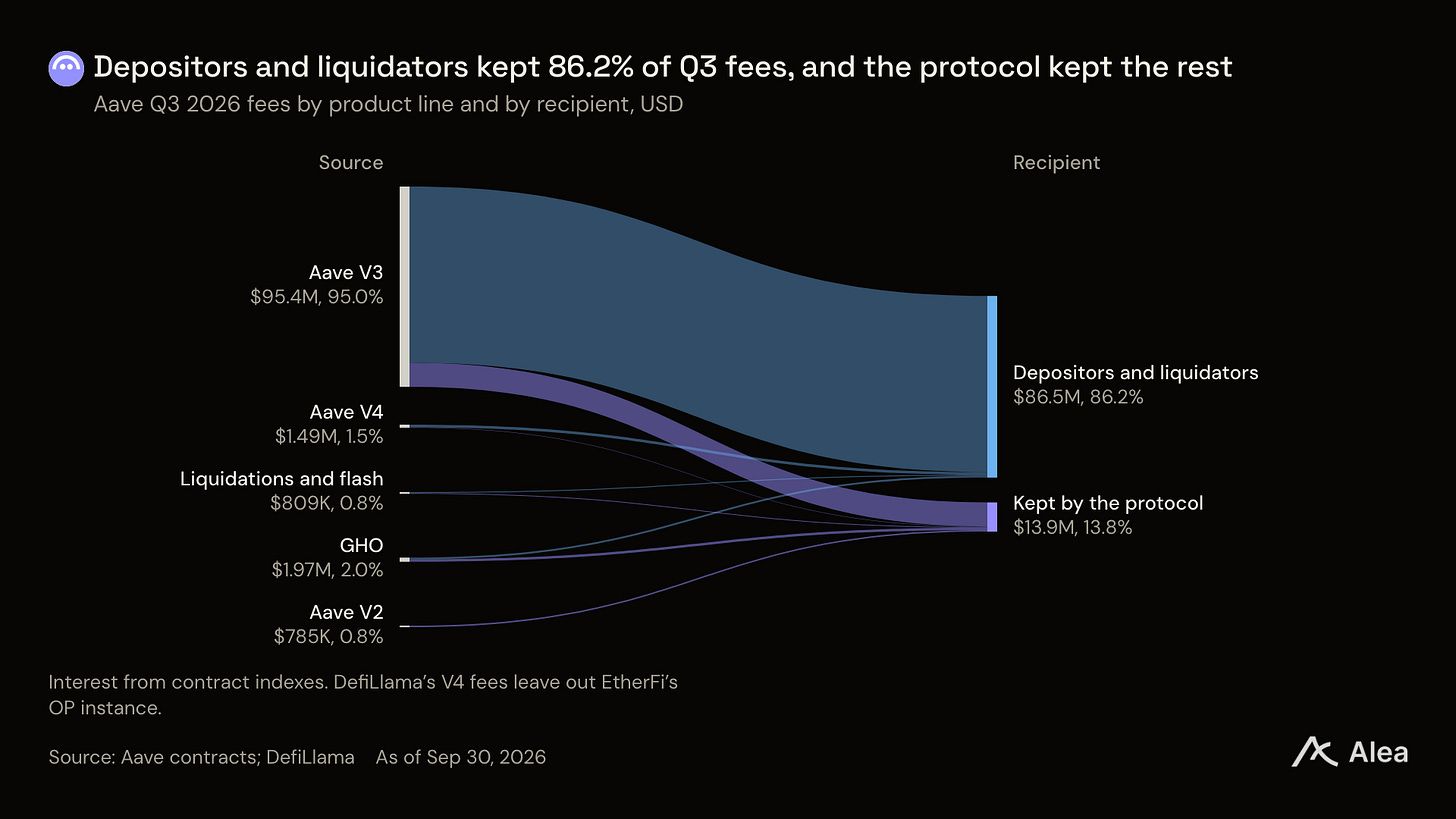
The reserve factor is the share of interest the DAO keeps. The DAO's take on each loan is the borrow rate times the reserve factor. USDC paid about 4.4% in Q3 at a 10% factor, or 45 bps a year to the DAO per dollar lent, while WETH paid about 2.1% at 15%, or 31 bps. Across its markets, GHO gave the DAO 212 bps before savers; the DAO mints GHO and keeps all of Ethereum Core's GHO interest. The DAO also paid GHO savers $1.90M from its treasury in Q3. After those savers, GHO roughly broke even.
After the quarter
V4's loans passed $500M in October. Avalanche's hub grew 5.7x after Sep 30, to $216M, with most of the rise on Nov 1. On Nov 4 Aave listed the tokenized stock SPCXc on Base's Equities Hub. Two days later Aave Labs bought Avon's team and technology to bring fixed-rate loans to Aave. On Nov 10 Aave risk manager LlamaRisk proposed freezing rsETH, osETH, LBTC, tBTC and rETH on V3 Core. With a group of smaller reserves, the plan covers $1.33B of collateral behind $1.03B of debt on Nov 9, and moves those borrowers toward V4, where a risk premium prices that collateral.
On Oct 29 a thief who had drained Binance hot wallets supplied 60M USDT on Aave and borrowed 19,762 WETH against it. Aave's guardians began freezing markets 78 minutes after the theft and had frozen 292 reserves across V3 and V4 within 160 minutes. Markets reopened on Oct 30 with borrow caps cut close to use. On Nov 4 a liquidator repaid 9,884 WETH of the thief's debt and took 24.4M USDT; after the liquidation, the position held a health factor of 1.16. On Nov 8, USDT, USDC and USDT0 still couldn't back new loans. That day those three held $7.3B or 26% of V3's deposits. Yet on Nov 2 the stewards named them as the next assets they would consider restoring.
Modeling: what a buyback restart takes
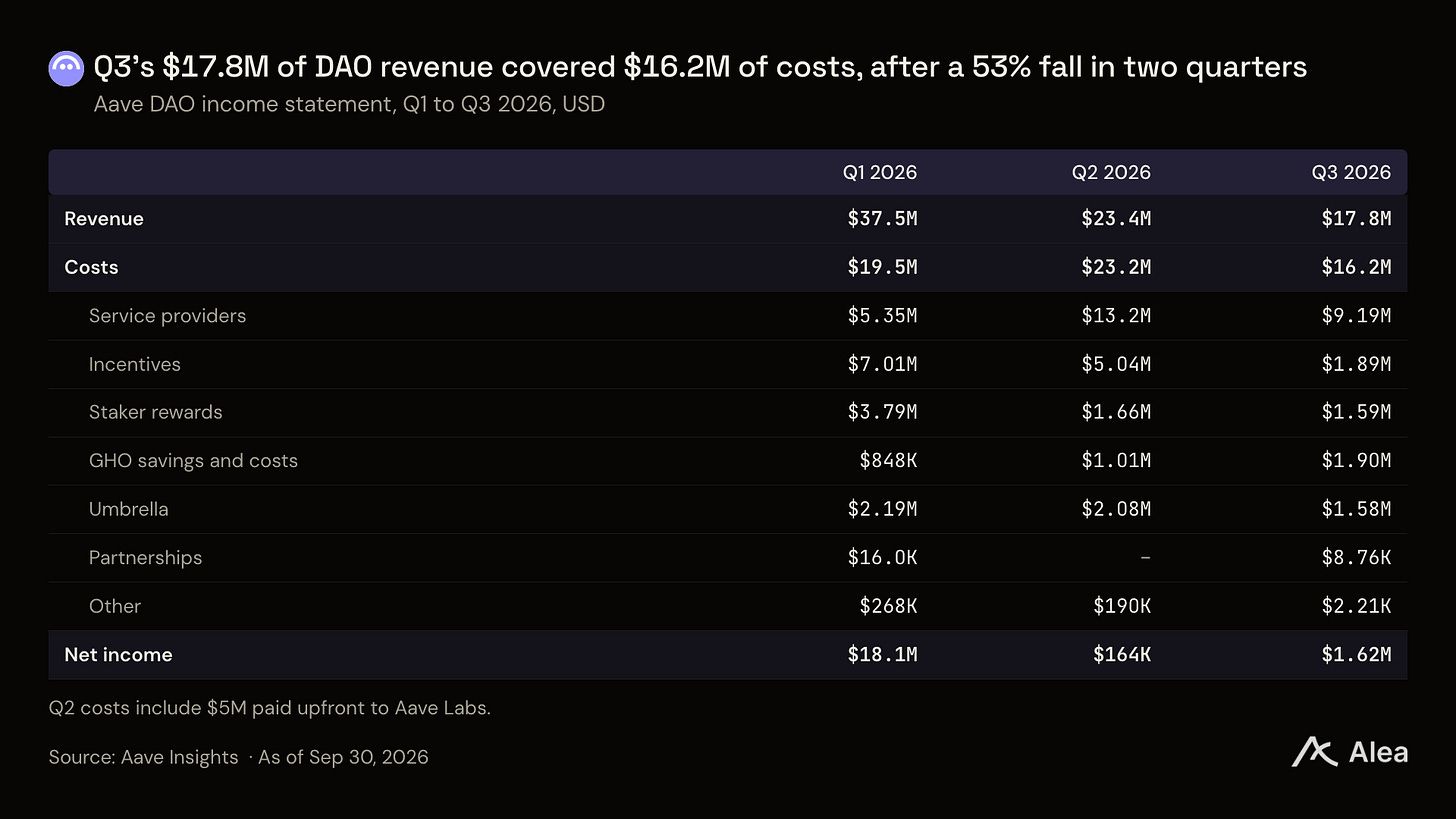
DAO revenue has topped costs every month since August. In Q3, $17.8M of revenue covered $16.2M of costs. Revenue fell 23.9% quarter over quarter as April's rate spike rolled out. Costs fell 30.3% from Q2's $23.2M, or about 11% without the $5M Q2 paid upfront to Aave Labs under its grant. October kept the run going, at $6.77M against $5.95M. The statement leaves out the rsETH recovery: the DAO paid $39.24M in May and still owes 8,000 ETH.
AAVE carries no automatic claim on fees; buybacks are the route from fees to holders. The DAO's treasury managers paused them on Apr 19, the day after the rsETH exploit. On Jul 6 Aave founder Stani Kulechov previewed automated buybacks under Aavenomics 3.0.
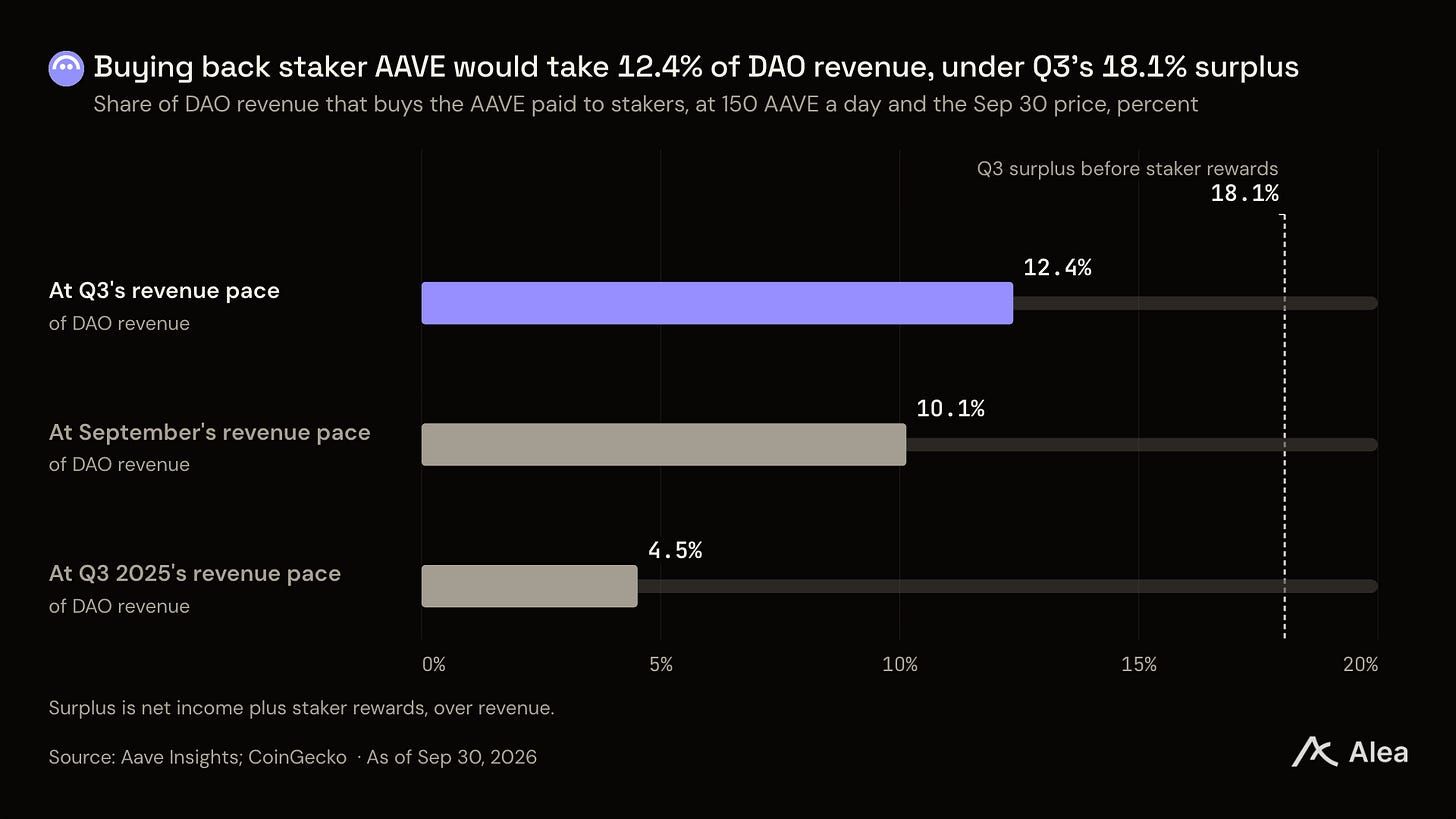
Stakers earn 150 AAVE a day, drawn from the DAO's own reserve. At the Sep 30 price, buying that AAVE back would take 12.4% of Q3 DAO revenue, under Q3's 18.1% surplus before staker rewards. That surplus keeps covering the buyback while DAO revenue stays above about $16.8M a quarter, 6% under Q3's pace, with costs held at Q3's level. Umbrella's reward period is one of those costs. It ends on Dec 2. October's $6.77M came almost all before the Oct 29 freeze. That cushion assumes USDT, USDC and USDT0 can back new loans again, and that no recovery loan draws on revenue.
April's deficit comes first, though. On Apr 18 an attacker forged a bridge message for Kelp's restaked ETH token rsETH and borrowed against the stolen tokens on Aave; Aave's contracts worked as written. The loans left a hole of about 83,800 ETH in Aave's WETH pools, $179M on Nov 8. The 30,766 ETH frozen on Arbitrum and other idle ETH count toward it but have not reached Aave's pools. On Nov 12 the frozen ETH was still idle, under a claim by holders of court judgments against North Korea that a New York court left open in May. About 51,400 ETH more, about $110M, must come from pledges or the DAO.
The DeFi United coalition lists enough pledges on paper, including Mantle's credit line of up to 30,000 ETH, but they fill the hole only if those loans draw. Mantle's loan, if drawn, takes 5% of Aave's protocol revenue as collateral.
The DAO still owes 8,000 ETH of it, about $17M against the $101M its treasury held outside AAVE on Nov 9. Depositors' aWETH balances never fell, but 2.5% of Core's aWETH and 31.3% of Arbitrum's have no WETH behind them until the hole is filled.
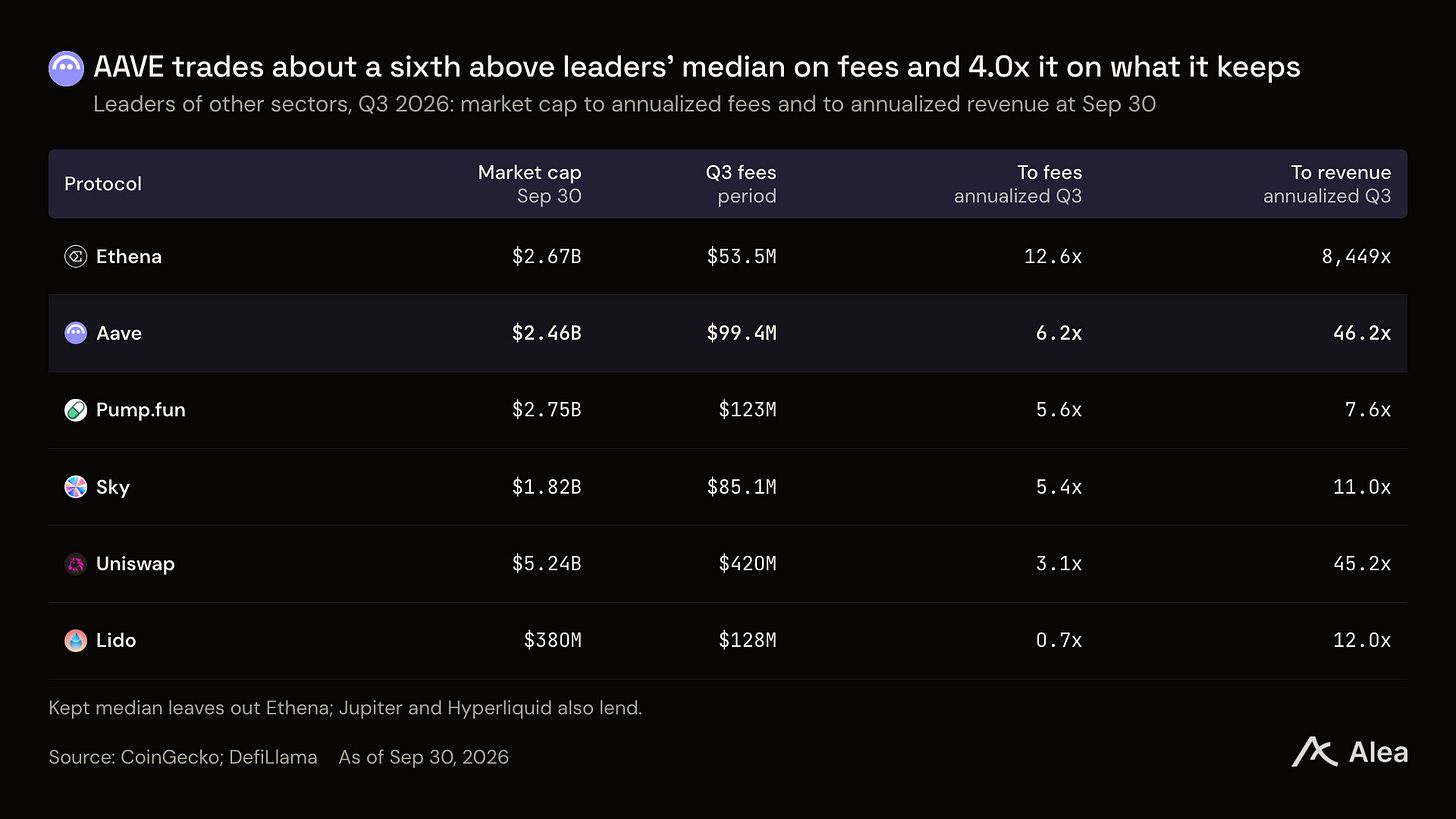
On market cap to fees, AAVE trades about a sixth above the median of five leaders of other sectors, such as Ethena and Pump.fun. On what the protocol keeps, AAVE ended Q3 at 46x, about 4.0x the 11.5x median of the four leaders with meaningful revenue. That multiple uses one provider's count for every leader and for Aave: $13.4M of fees kept in Aave's Q3, against $13.9M on Aave's own count. Matching the 11.5x median at the Sep 30 market cap takes $214M a year, against $53M at Q3's pace.
Reaching $214M at Q3's fee pace on that provider basis means keeping 54 cents per fee dollar, or fees back at Q1's $766M run rate with a 28-cent take. The partner deals with published dollar terms add $3.0M to $3.2M a year: Arc's floor and EtherFi's share at its target. The path to a higher take runs through votes the DAO controls: the reserve factors, GHO and the terms of each partner deal. One such vote is already up: on Nov 12 TokenLogic proposed higher reserve factors on 54 reserves, about $3.5M a year more for the DAO at Nov 9 balances. Each of those votes prices take against share, beside a rival in Morpho that keeps none of its fees.
Important Links
Disclosures
This report on Aave was not paid for or commissioned.
Members of the Alea Research team, including those directly involved in the analysis above, may have positions in the tokens discussed.
This content is provided for educational purposes only and does not constitute financial or investment advice. You should do your own research and only invest what you can afford to lose. Alea Research is a research platform and not an investment or financial advisor.

The Aave Q3 2026 Benchmark takes this market by market, with GHO, Umbrella and the rsETH recovery, the AAVE holder base, and Aave and Morpho chain by chain. Its IR deck carries the same evidence in slides.
Aave's Data Room on Alea tracks its lending, fees and governance in one place, with Analytics for its history and Intel for its news and votes.
Research reports. Deep Dives and Blueprints explain protocols and their economics. Theses and Memos examine investment cases and catalysts. Benchmarks compare performance, while Perspectives assess specific developments.
Weekly Pulse. Read a weekly assessment of macro and the major liquid markets.
Protocol Data Rooms. Research each protocol in one place, with Analytics for historical comparisons and Intel for news and governance developments where available. Open Aave Analytics. Open Aave Intel.
Podcast Digest and Summit Digest. Read summaries of industry conversations and events. Find Alea shows and their episodes through Podcast Digest.
Governance Tracker. Follow proposals and voting activity across protocols.
For protocol teams preparing institutional conversations, discuss research for your protocol with Alea.