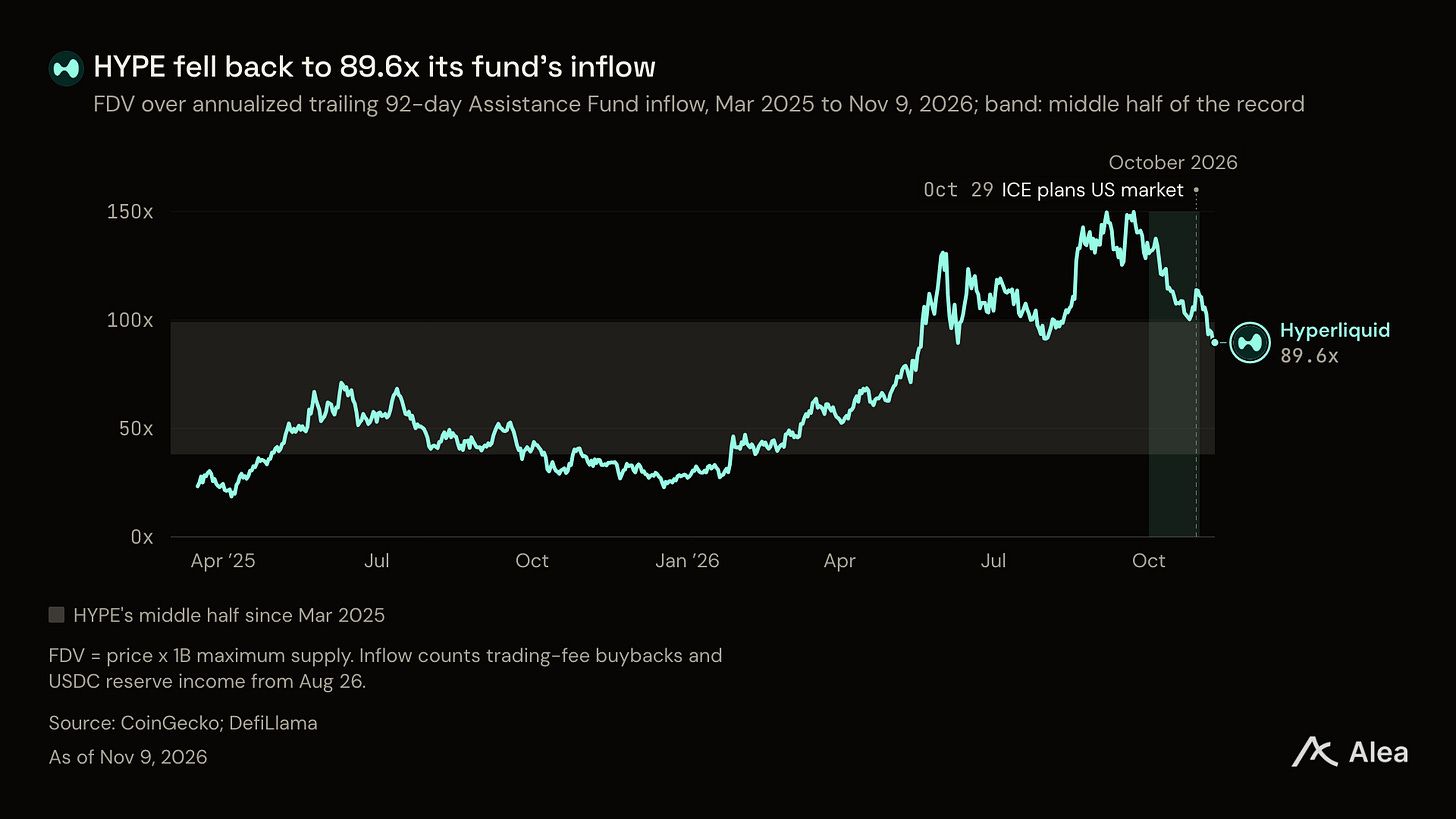
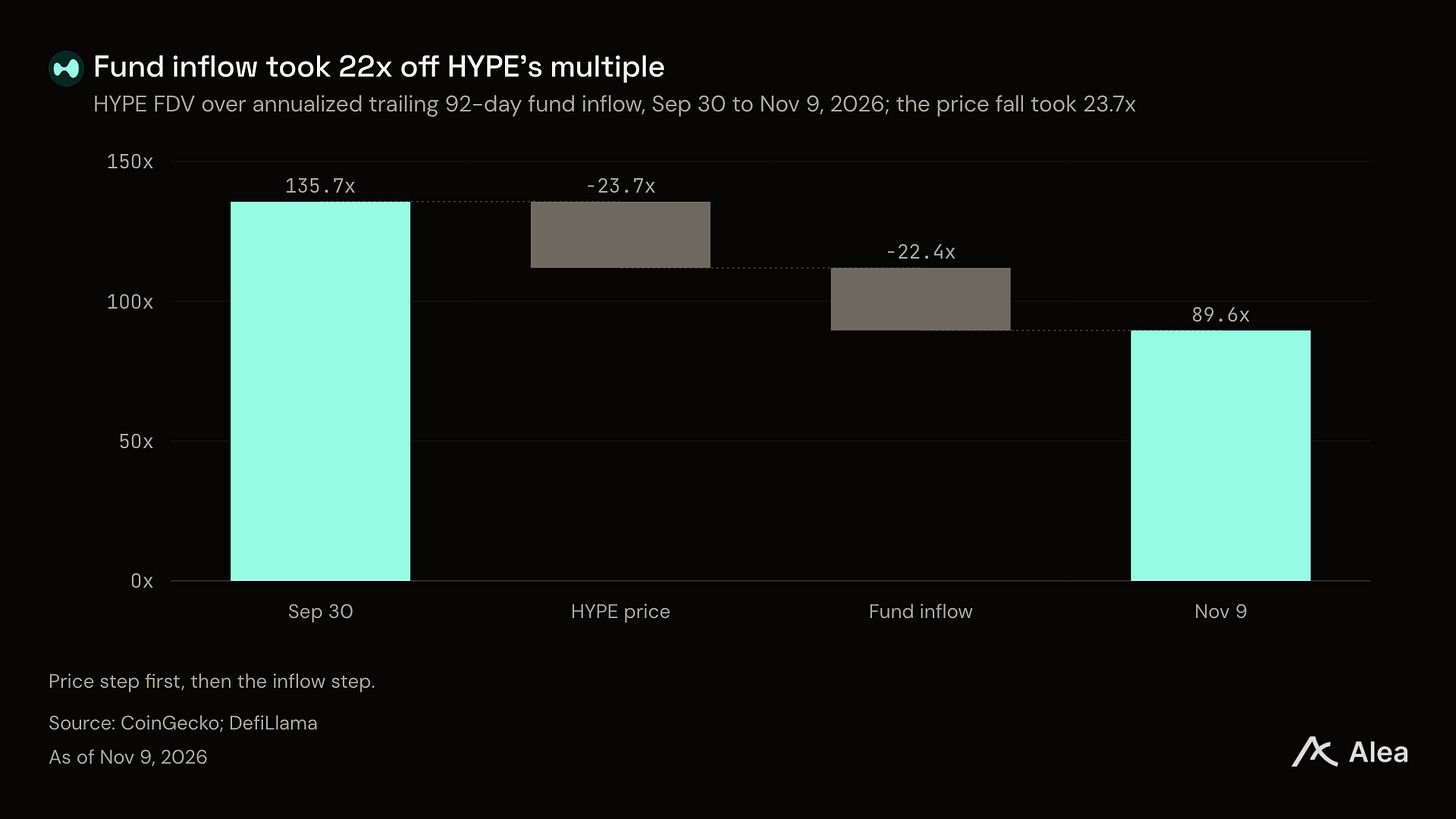
HYPE got cheaper twice in six weeks: once on price and once on inflow. The token closed Nov 9 at $75.10, down 17.5% from Sep 30. The Assistance Fund buys HYPE with Hyperliquid's fees and treats it as burned. The fund took in $2.21M a day from Oct 1 to Nov 9, 20.2% above its Q3 daily average. Most of that gain came from Coinbase's USDC reserve payments, which began accruing only on Aug 26. On the same comparison, trading inflow alone was up just 2.4%. HYPE's fully diluted value fell from 135.7 times the fund's annualized 92-day inflow to 89.6 times, and price and inflow each explain about half of that fall.
Key Takeaways
USDC reserve income supplied 23.8% of the fund's October inflow, against 10.5% in Q3. At its Nov 9 rate, that income comes to about $189M a year.
The fund's inflow bought 7.8% more HYPE a day than in Q3, though HYPE's average price was higher in Q4 than in Q3. That comes to 26,704 HYPE a day in Q4 through Nov 9, against 24,775.
Outside teams' HIP-3 markets carried 43.8% of perp volume in early November, and each 10 points of that share came with a 0.27 bps lower take. The take is the fund's cut of each dollar traded. Core markets pay it about 3 bps; trade[XYZ]'s stock, index, and commodity markets pay far less.
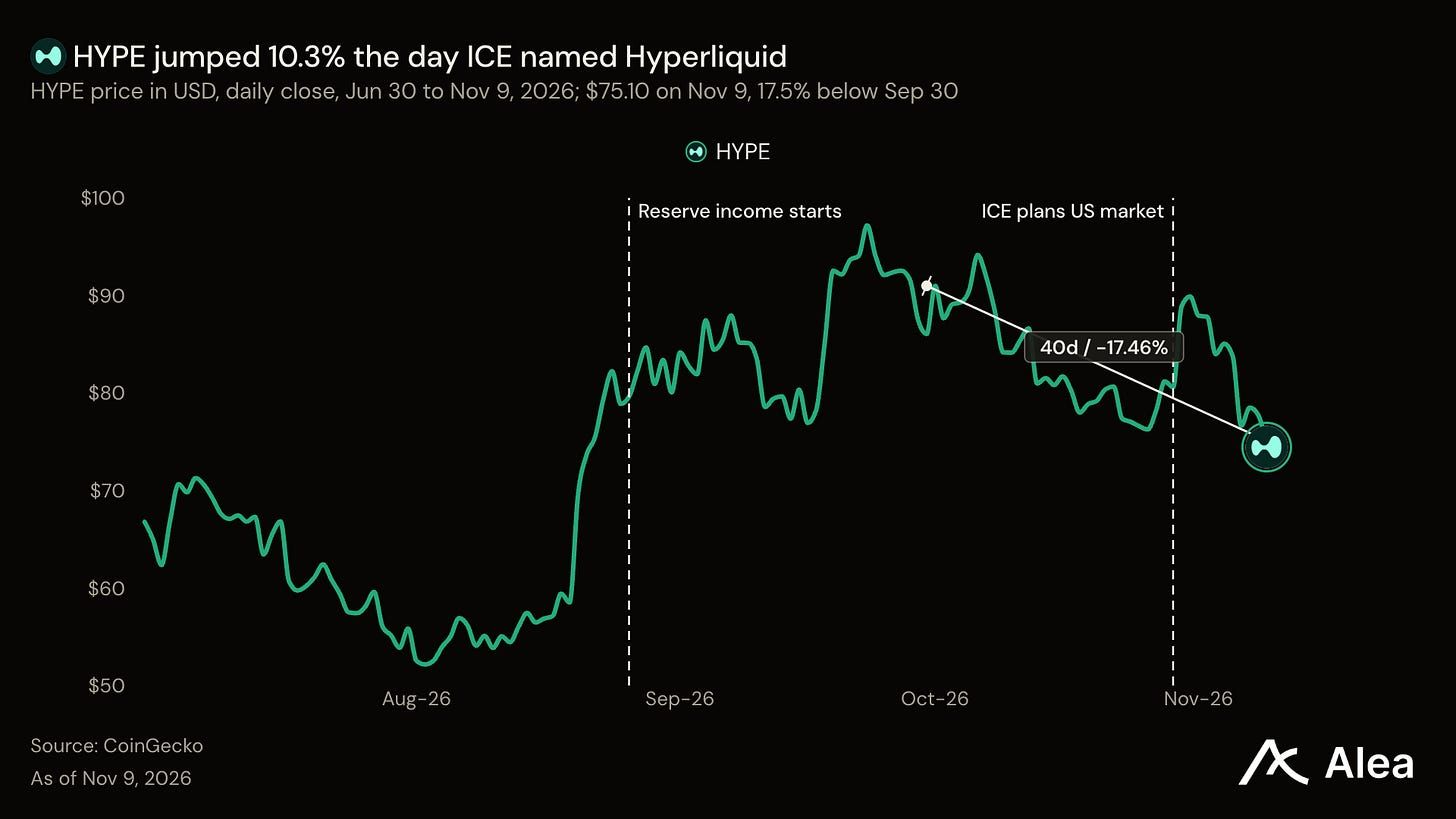
Every layer of a regulated US perp market now has a named firm on Hyperliquid. Two stacks are planned: ICE with trade[XYZ], and Payward's Bitnomial with NinjaTrader Clearing. A Hyperliquid Strategies subsidiary applied to carry client accounts as a futures commission merchant. Each US role still waits on CFTC approval and on HIP-3's permissioned form HIP-3* going live on mainnet.
Apps outside the US already bring their users to the same order book. Bitso opened more than 200 Hyperliquid perps to its users on Nov 9, after Pumpfun in late October and Coinbase's Base App in August.
Every layer of a US perp market has a firm
Hyperliquid runs order books, margin, and settlement on one public chain, and any team that stakes 500,000 HYPE can list its own perps there under HIP-3. HIP-3* adds an onchain allowlist that lets a regulated firm run permissioned markets on the same engine, and as of Nov 12 it was live only on testnet.
Three groups named their roles between Sep 16 and Nov 5, and each US market still needs CFTC approval. Kraken's parent Payward went first on Sep 16. Its Bitnomial would create, own, and clear US markets as a CFTC-regulated exchange and clearing house, with NinjaTrader Clearing carrying client accounts. On Oct 29 the New York Stock Exchange's owner ICE announced that trade[XYZ] would design markets while ICE would run the regulated market and clearing. On Nov 5 the Nasdaq-listed HYPE treasury company Hyperliquid Strategies said a subsidiary had applied to become a futures commission merchant for HIP-3* markets.
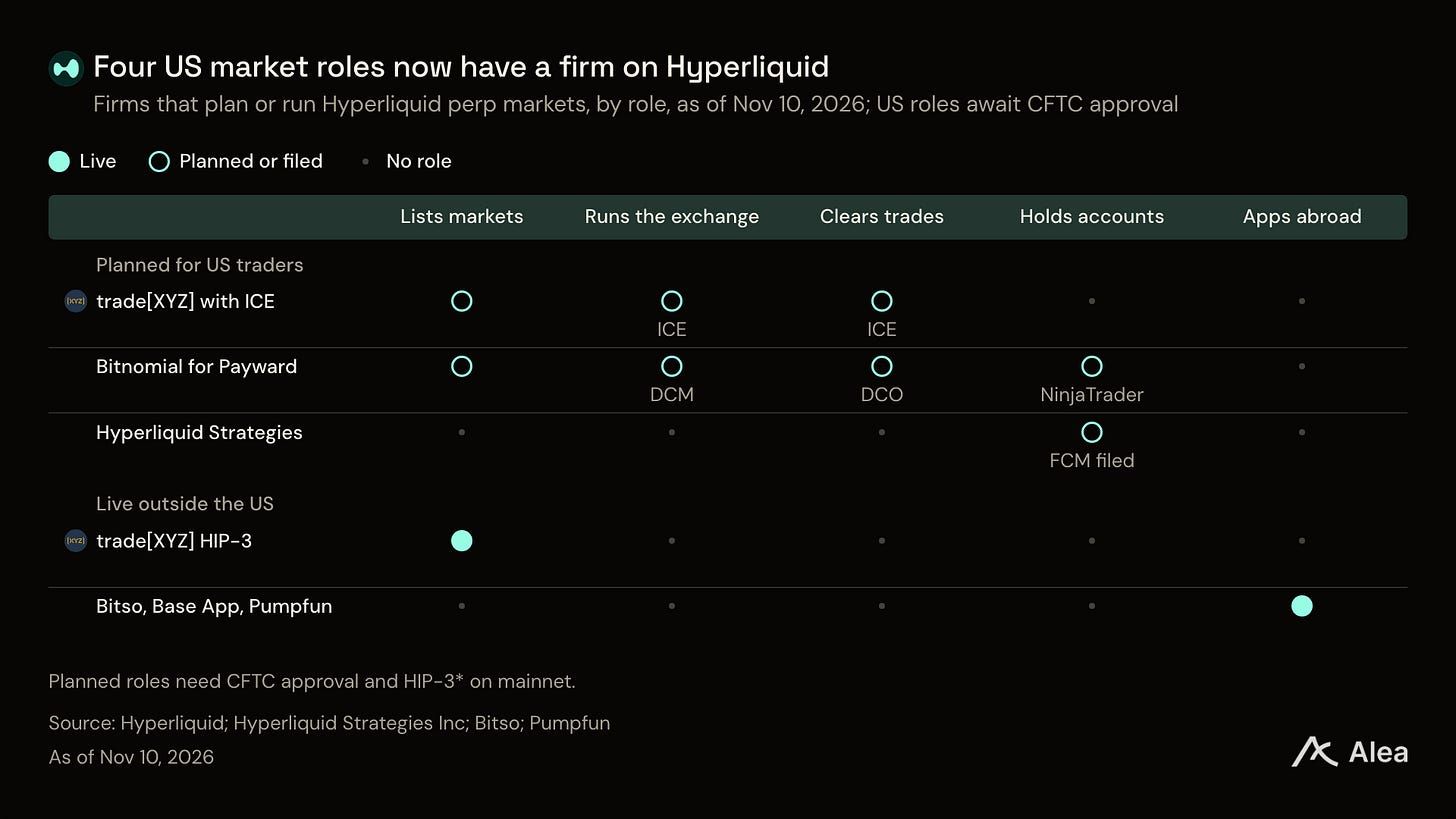
HYPE rose 10.3% the day ICE named Hyperliquid, while bitcoin fell 4.2%. Outside the US, apps already rent the order book through builder codes and bring their own users.
HIP-3 grows volume and thins the take
Perp volume ran $9.89B a day in November's first nine days, 27% above the Q3 pace after a flat October. HIP-3 markets carried 43.8% of it, their highest share since July's 51%. Almost all of that, 98%, ran on trade[XYZ], led by its XYZ100 index, S&P 500, and SK hynix markets.
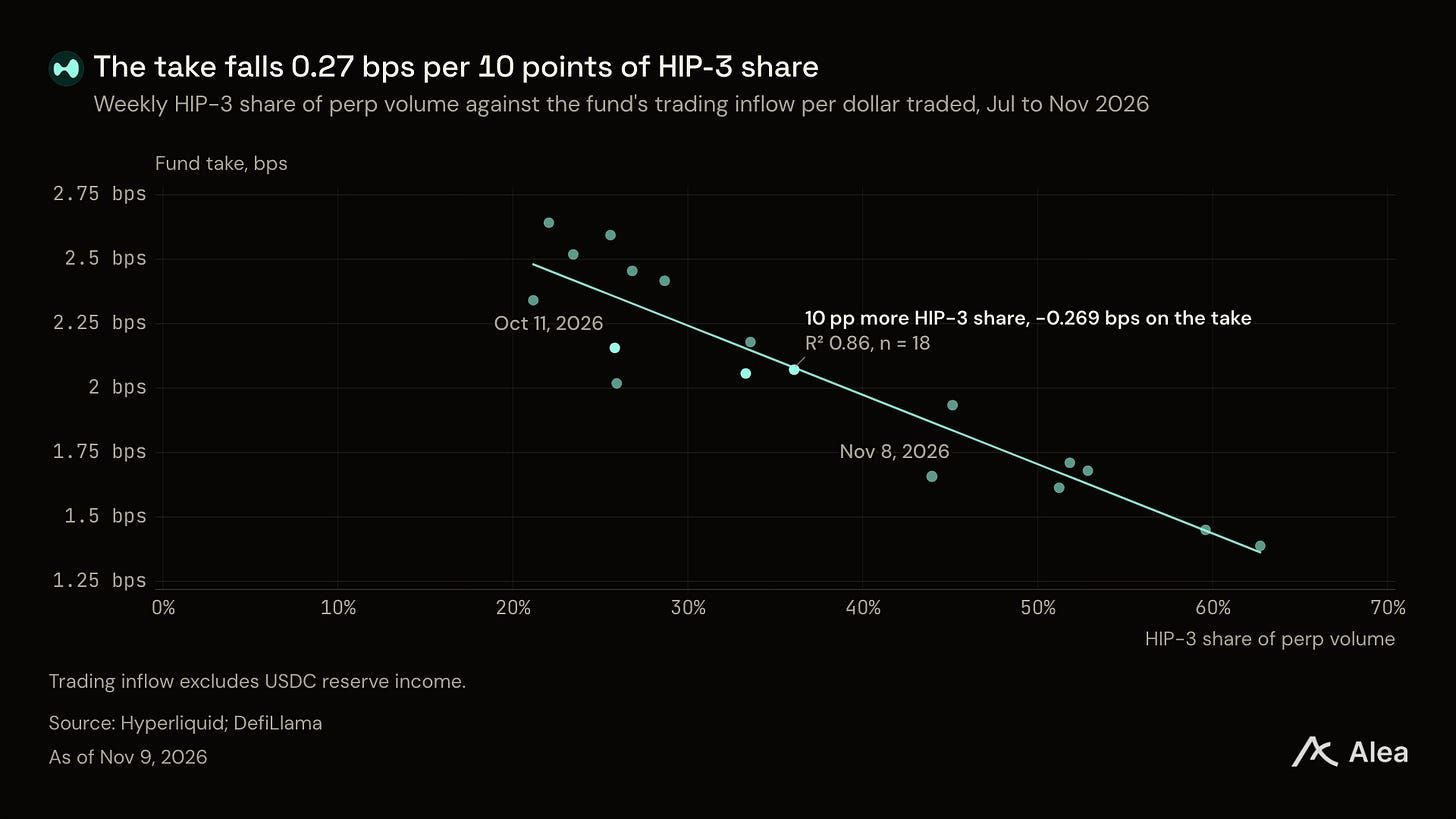
The mix sets the fund's take, while volume sets the dollars. Week by week since July, each 10 more points of HIP-3 share came with a take 0.27 bps lower per dollar traded. With no HIP-3 volume, the take would be about 3.05 bps, the rate core markets pay. Growth mode explains why HIP-3 markets pay less. Hyperliquid's fee schedule cuts the protocol's fee on a HIP-3 market in growth mode to a tenth of the normal rate, and most of trade[XYZ]'s markets run in it. Deployers charge their own fee on top. Growth mode is a trade-off: deployers cut the price to win volume, and the fund collects less per dollar. If 10 points of volume moved from core markets to HIP-3 markets at November's pace, the fund would take in about $97M a year less.
The next move on the take is trade[XYZ]'s. Growth mode caps a deployer's own fee share at 100% of the base fee, against up to 300% outside it. Each switch also locks a market for 30 days. Leaving growth mode would lift both the fund's cut and trade[XYZ]'s own, but it would raise prices for the traders who made trade[XYZ] the largest HIP-3 venue.
Reserve income covers that $97M about twice over. Under Hyperliquid's aligned quote asset rules, Coinbase pays the fund about 90% of the net return on the Treasury bills behind the USDC held on Hyperliquid, every 30 days. Coinbase pays because a future upgrade will let only aligned stablecoins quote Hyperliquid's main perp markets. The second payment, $15.92M, arrived on Nov 3. USDC on Hyperliquid stood at $6.53B on Nov 9, 12.0% below Sep 30. Each 25 bp Fed cut takes about $15M a year off that income.
Coinbase cannot stop quietly. The rules make it stake 500,000 HYPE, which validators can slash if a payment falls short, and give six months' notice before it stops paying. The next payment is due around Dec 3. On the accrual through Nov 11, it comes to about $15.4M, just under November's.
Higher inflow cut 22.4 turns off HYPE's multiple
Price and inflow split the drop almost evenly. The price fall cut 23.7 turns off the multiple, and higher inflow cut the other 22.4. The multiple's base is the fund's annualized inflow over the past 92 days. It rose 25.0%. That beats the 20.2% gain in the daily average because the days the window dropped, in July and early August, were weak and held no reserve income.
Staking and unlocks added about 41,600 new HYPE a day in Q3. At that pace, the fund's Q4 inflow absorbs all new supply only while HYPE trades below about $53. At the Nov 9 price, it absorbs about 71%. Since a validator vote in December 2025, the fund's 48.8M HYPE counts as burned. Hyperliquid Strategies is the other steady buyer: it bought 9.1M HYPE in Q3 for $785M, more than twice the quarter's new supply.
That buyer has a budget. On Oct 28 Hyperliquid Strategies had $245.3M of cash left. That buys about 3.3M HYPE at the Nov 9 price, roughly 80 days of new supply at Q3's pace. After that, it buys only as fast as it sells new shares, and its equity facility had raised $1.58B by Oct 28.
Q4 beats Q3 if volume holds above $6.2B a day
The fund took in $169.1M in Q3. By Nov 9, Q4 had brought in $88.4M, just over half of that. To pass Q3, November and December need $50.1M a month, 27% below October. The fund's inflow in November's first nine days ran 2% below its October daily pace and 12% below September's peak.
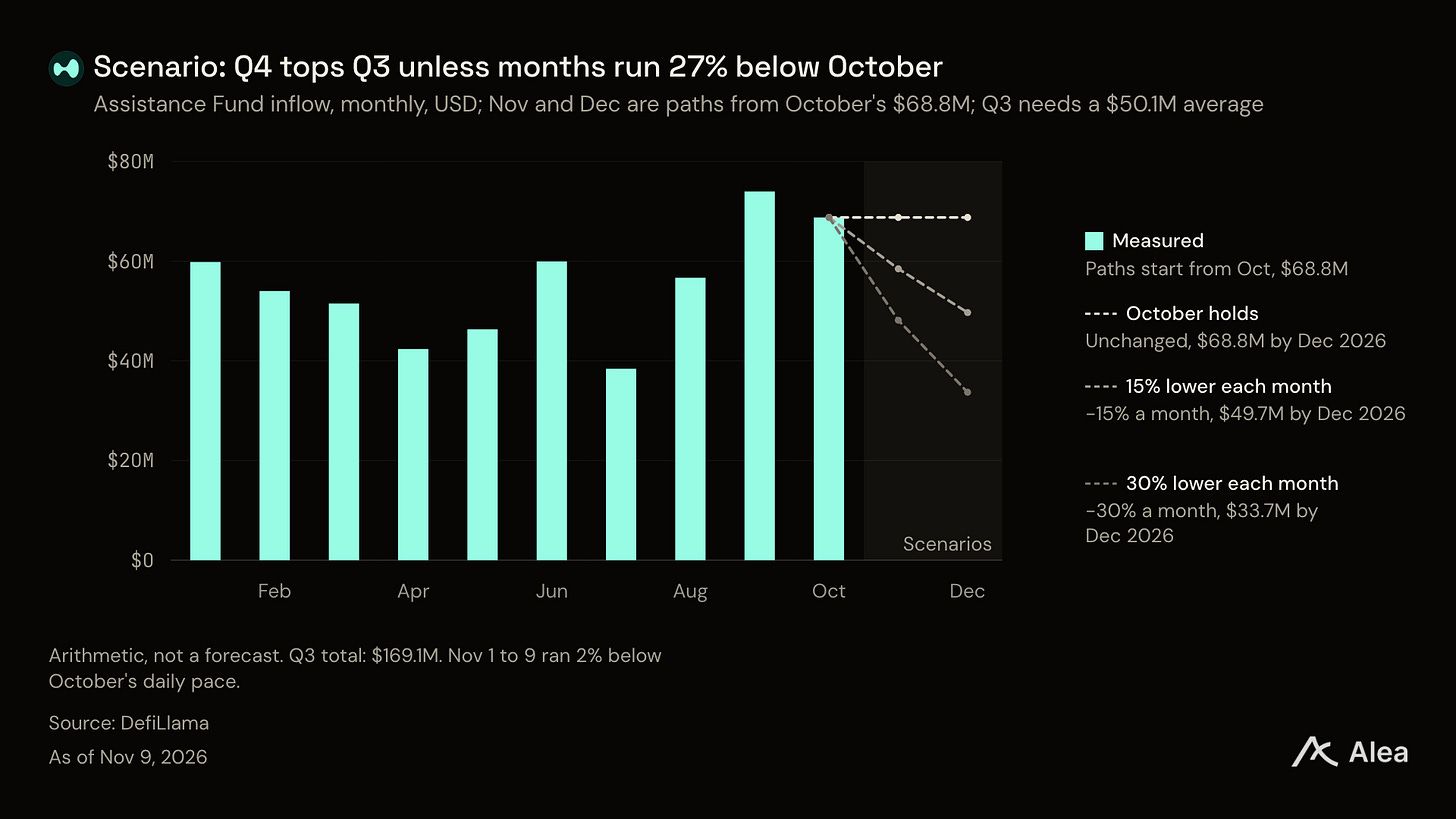
To match Q3, the fund needs $1.55M a day over the last 52 days of the year. Reserve income supplies about $0.52M. The other $1.03M must come from trading fees. At November's take of 1.68 bps, that means $6.2B of perp volume a day. Q3 averaged $7.78B, and early November $9.89B. A lower take raises the threshold: at 1.4 bps, it's $7.4B.
Three events would change the fund's income. Reserve income stops covering that $97M if USDC on Hyperliquid falls by about half, to $3.4B, at November's rates. The take moves back toward core's rate if trade[XYZ] moves its markets out of growth mode, or if HIP-3's share falls. And US volume reaches the fund only after HIP-3* goes live on mainnet and the CFTC approves each role. Neither step had a date on Nov 12.
The fund now has two payers. Traders pay through fees, at a take that thins as HIP-3 markets grow. Coinbase pays through the return on USDC, which shrinks as USDC leaves Hyperliquid and as the Fed cuts. Until US markets open, the fund's growth rests more on Coinbase than on traders, and every Fed cut trims it.
Important Links
Hyperliquid Q3 2026 Benchmark · Hyperliquid Q3 2026 IR deck · HIP-3 builder-deployed perpetuals · Aligned quote assets · Hyperliquid fee schedule · Hyperliquid Strategies Q3 results
The Hyperliquid Q3 2026 Benchmark has the full numbers on volume by market, the Assistance Fund by source, HIP-3 deployers, and HYPE's multiples. Its IR deck makes the same argument in slides.
Disclosures
This report on Hyperliquid was not paid for or commissioned.
Members of the Alea Research team, including those directly involved in the analysis above, may have positions in the tokens discussed.
This content is provided for educational purposes only and does not constitute financial or investment advice. You should do your own research and only invest what you can afford to lose. Alea Research is a research platform and not an investment or financial advisor.

Alea tracks Hyperliquid's volume, fees, and HIP-3 markets in one place, with Analytics for their history and Intel for the news.
Research reports. Deep Dives and Blueprints explain protocols and their economics. Theses and Memos examine investment cases and catalysts. Benchmarks compare performance, while Perspectives assess specific developments.
Weekly Pulse. Read a weekly assessment of macro and the major liquid markets.
Protocol Data Rooms. Research each protocol in one place, with Analytics for historical comparisons and Intel for news and governance developments where available. Open Hyperliquid Analytics. Open Hyperliquid Intel.
Podcast Digest and Summit Digest. Read summaries of industry conversations and events. Find Alea shows and their episodes through Podcast Digest.
Governance Tracker. Follow proposals and voting activity across protocols.
For protocol teams preparing institutional conversations, discuss research for your protocol with Alea.