Eleven Saturdays and Sundays since October began each earned Kalshi more in fees than midterm election day did. That's the business investors bought at $40B in late October: a fee engine built on weekend sports and combos, the parlays that pay only if every leg wins. It costs 8.2 times its recent fees, below CME, and its fees have grown faster than its valuation at every round. The states now decide whether those weekends stand. Sports and combos earn three-quarters of the fees, and they are the contracts states are fighting in court.
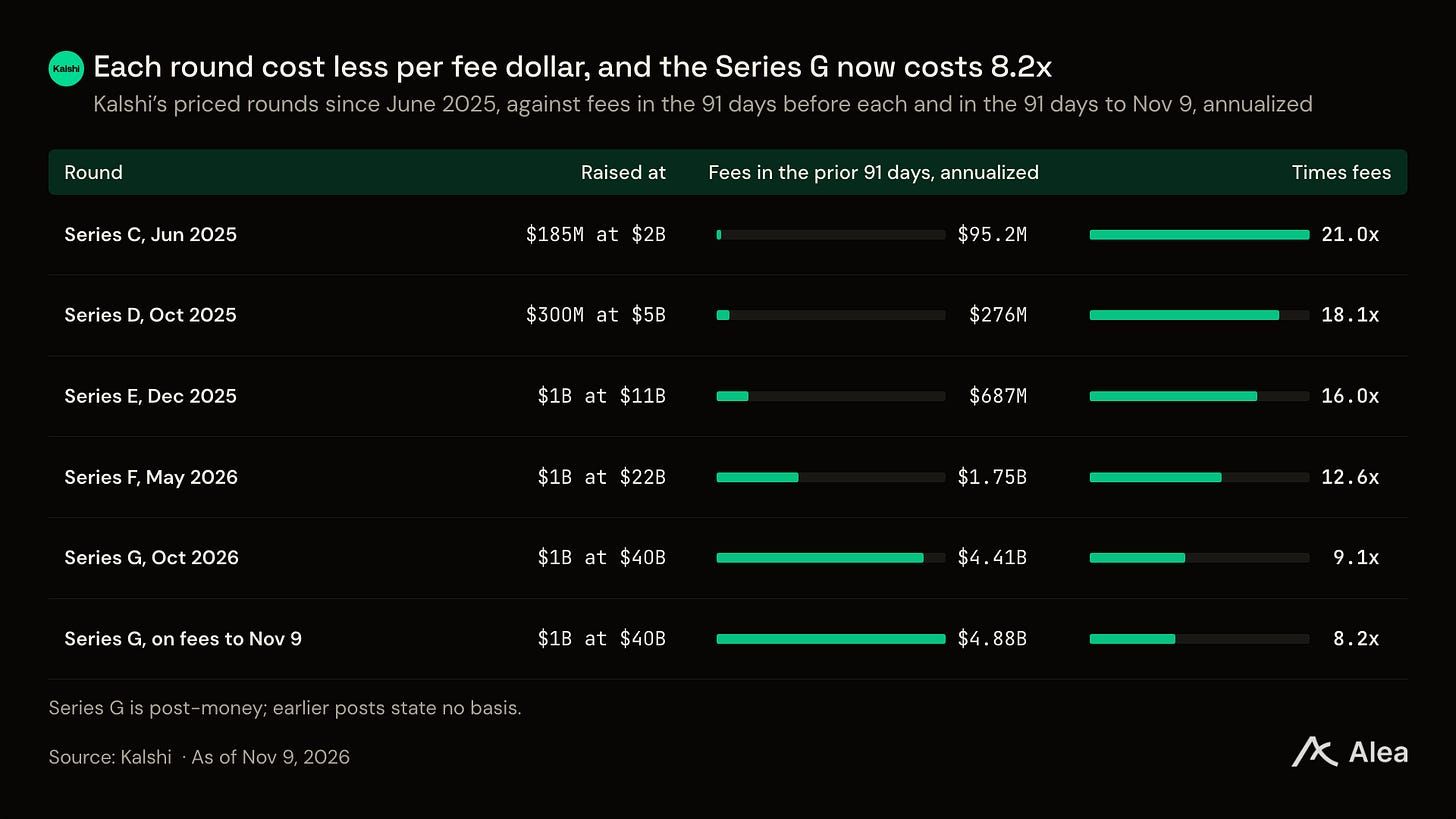
From the June 2025 Series C to the Series G, Kalshi's valuation grew 20-fold while its fees grew 46-fold, and fees kept climbing after the round closed.
Key Takeaways
On a full year of fees, the Series G costs 14.5 times, below CME's 15.7 times revenue. On recent fees it cost 9.1 times the day it closed and less since.
Q4 earned $653M of fees in its first 40 days. That is two-thirds of Q3's $978M. A $1B quarter needs only $6.67M a day from here, well under Q4's pace to date.
Combos added $3.13M of the $5.69M rise in fees per day from Q3. In 40 days they out-earned their whole Q3.
Politics traded $211M on election day but earned $3.31M in fees. Most of that money bought near-certain winners, where the fee is smallest.
The Series G pays for a stocks expansion that began on Nov 5, when single-stock perpetual futures launched. In five days, they traded $1.13B of notional on Kalshi.
Fees per day climbed each month, rising from $12.2M in September to $19.0M in the first nine days of November.
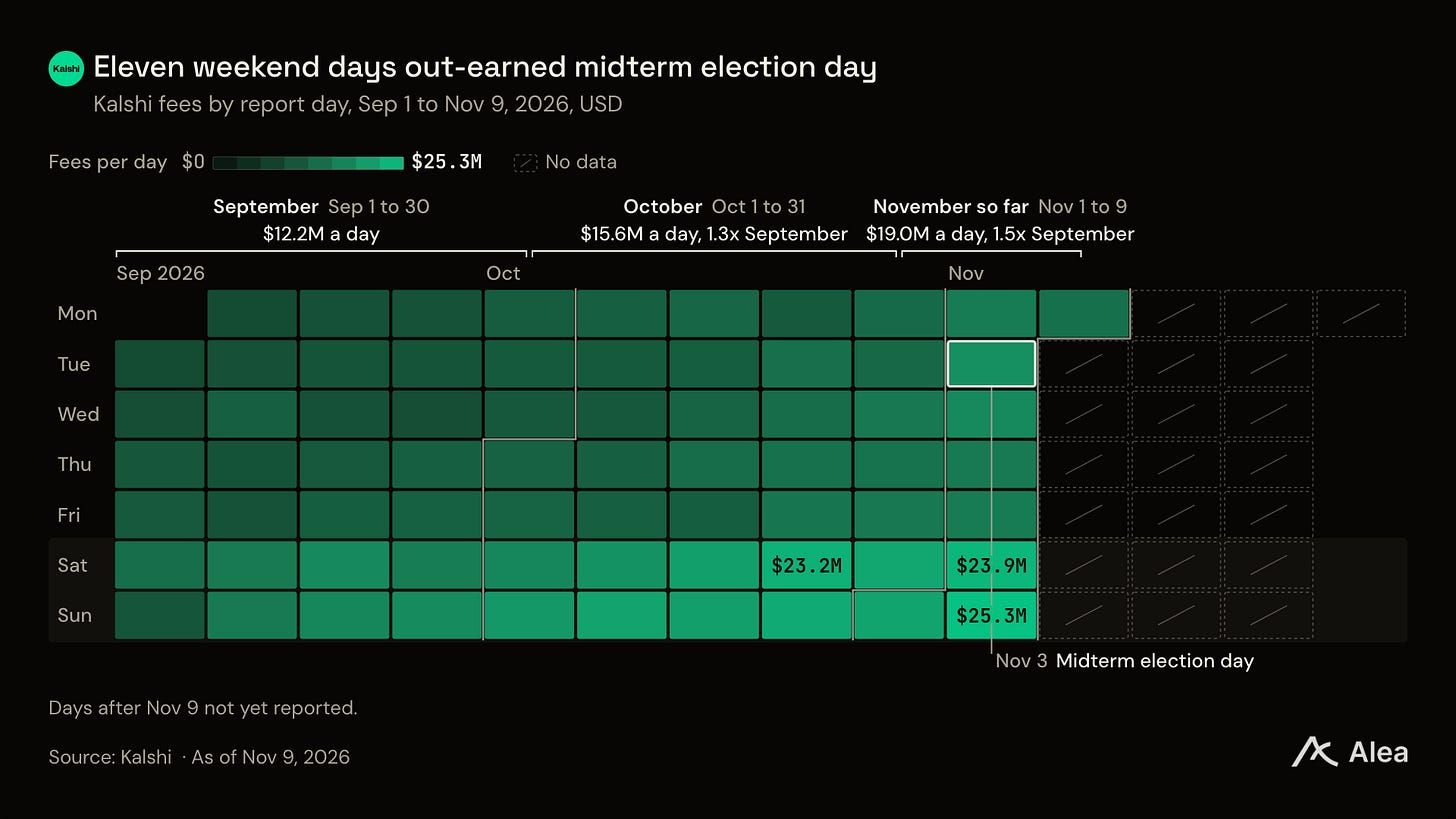
The Sunday after the vote was the best day: it earned $25.3M, 35% more than election day.
Election day paid less than a football Sunday
On Nov 3, Kalshi's favorites won 479 of the first 487 races decided. Kalshi puts midterm volume at $2.5B, nearly double the 2024 cycle, counting each contract at $1. Even that day, sports out-earned politics, $5.83M to $3.31M.
Kalshi charges a fee on each trade: 7% x contracts x price x (1 - price). Per dollar traded, that is 7% x (1 - price), which charges longshots the highest rate. A 5-cent longshot pays 6.65% of its price. A 95-cent favorite pays 0.35%.
Election day traded favorites.
In the key Senate races, Kalshi's markets had the winner at 99% or more an average of 115 minutes before CNN called them. More than half of election day's politics money, $117.5M, bought contracts priced at 90 cents or more. That left the politics fee at 1.57% of each dollar traded, about half of Kalshi's 2.86% Q4 average through Nov 9. Politics earned less than a fifth of the day's fees.
Weekends trade the other end of the curve. On the best Sunday, sports and combos earned 87% of the fees. Because every leg must win, combos trade at low prices, where the fee per dollar is highest: in Q4 through Nov 9, they paid 6.12% of each dollar traded.
Combos now pay a third of Kalshi's fees
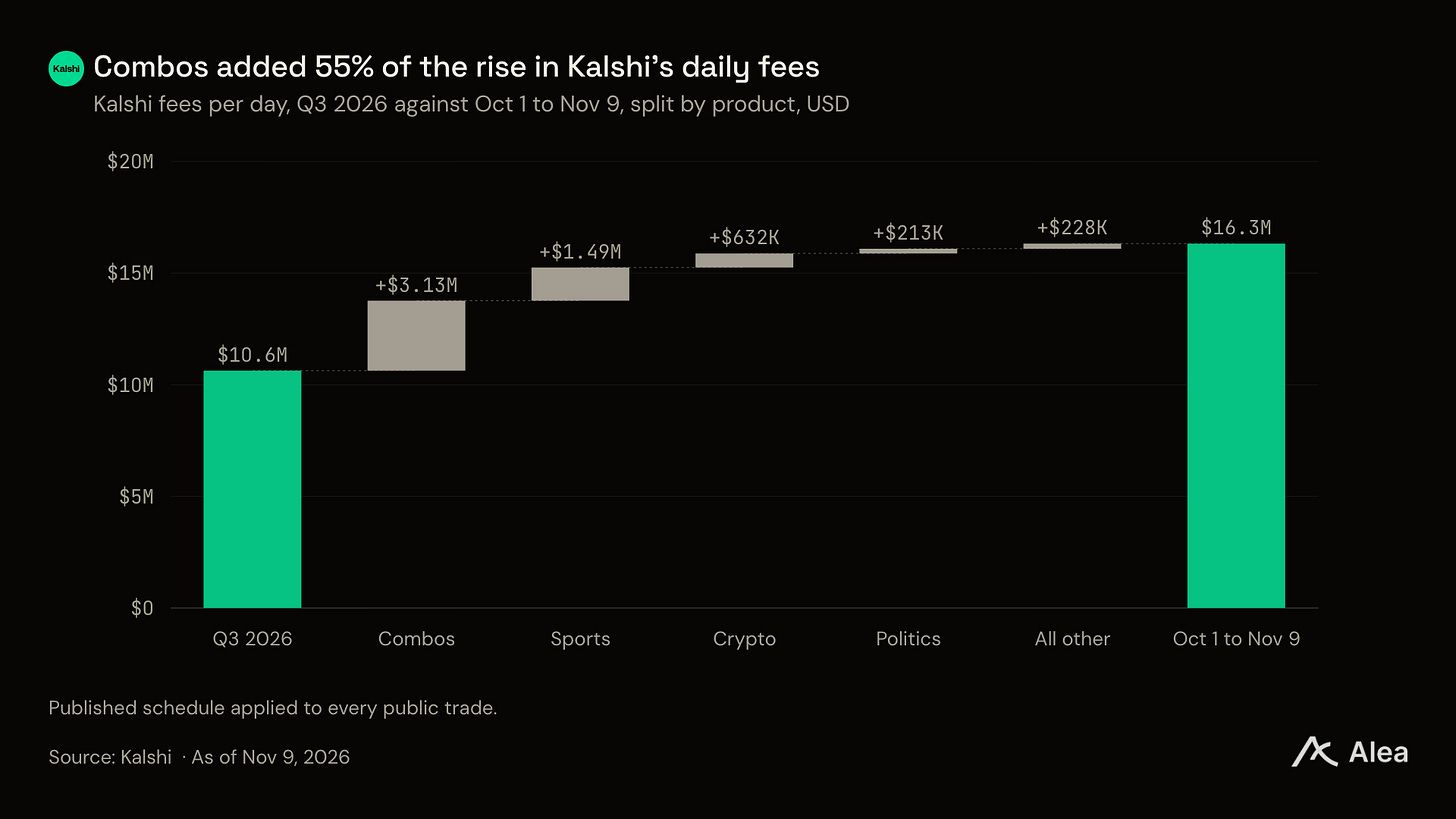
From Oct 1 to Nov 9, combos earned 33.3% of Kalshi's fees on 15.6% of the dollars traded. Their fees per day more than doubled from Q3. By Nov 8, they had passed their Q3 total of $211.9M. Part of the rise comes from a fee increase on Aug 20, when Kalshi added a maker fee on the resting order in three combo series at half the taker rate.
Combos are now Kalshi's second-largest source of fees, behind sports.
Sports added $1.49M a day. On the best Sunday, football series earned 59% of Kalshi's sports fees. Crypto prediction markets added $632K a day. Politics added the least, even with the midterms inside the window.
Cheaper than CME on a trailing year and on recent results
Wellington and Sequoia led the $1B round. Co-founder Tarek Mansour said the money funds stocks, compute, indices, and institutional trading. The announcement also names indices built with S&P and growth in Latin America and Europe.
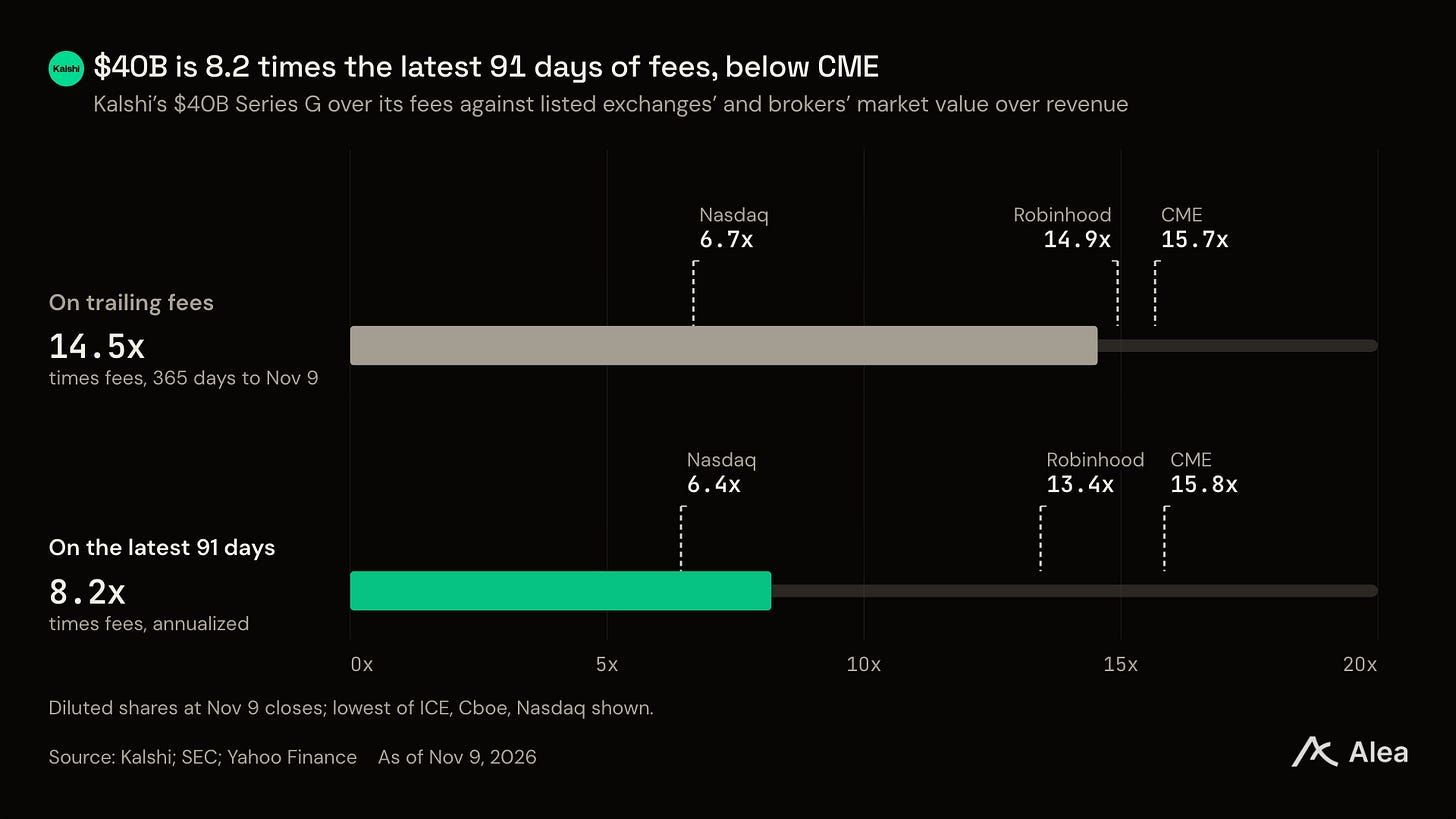
On a full year of fees, the round costs 14.5 times. CME trades at 15.7 times its revenue over the last four quarters, and Robinhood at 14.9 times. On recent results, annualized, Kalshi costs 8.2 times fees against CME's 15.8 times Q3 revenue.
These are gross fees, before rebates and incentives, and they leave out perpetual futures. Sports and combos earned 77% of them from Oct 1 to Nov 9, and those are the contracts that state cases and New Jersey's petition to the US Supreme Court challenge. The legal risk falls on the fee engine itself.
Trailing fees also start from a smaller business: Q4 2025 earned $213M. Each new quarter replaces a smaller one, which pulls the trailing multiple down. If Q4 holds $16.3M a day, it ends near $1.5B. The trailing-year multiple then falls to 11.5 times.
Without sports and combos, the round costs 33 times fees
Kalshi's round has slack. To cost what CME costs on its latest quarter, 15.8 times, Kalshi's fees would have to fall to $6.9M a day. That is roughly where fees ran in Q2 2026, before the football season. Q4 has run at more than twice that.
The mix is the risk. Over the latest 91 days, everything outside sports and combos, mostly crypto, earned at a $1.21B annual rate. Kalshi says its non-sports business already runs above $1B a year. On those fees alone, the round would cost 33 times. That is the range the state cases decide.
Kalshi also sets its own price, product by product. In August it halved fees on 19 baseball series. Two weeks later it added a maker fee to three combo series, where buyers already paid the most per dollar.
Stock perpetuals traded $1.13B in five days
Single-stock perpetual futures launched on Nov 5. Within five days, 58 of them had traded, SpaceX, Nvidia, and Micron among them. Co-founder Luana Lopes Lara said users traded over $300M on the first morning. Micron led with $195M of notional, just ahead of SpaceX. By then, Kalshi's crypto perpetuals on the same exchange had traded $92.3B of notional since their first trades in June.
A court case decides whether the product stays. On Nov 3, a federal judge in New York denied a request to halt stock perpetuals because the challengers showed no irreparable harm. Yet the same order found the challengers likely to win their claim that the CFTC lacked the authority to approve the product. US stock-trading incumbents Cboe and Citadel Securities filed declarations for the challengers. Coinbase and other trading platforms filed a brief on the CFTC's side.
The incentives are plain: Kalshi pitches the product against payment for order flow, which wholesalers such as Citadel Securities pay to brokers like Robinhood. Briefing on the challengers' bid for a preliminary injunction closed on Nov 10, and as of Nov 12 the court had set no hearing. An injunction would stop the stock product. It would not touch Kalshi's prediction-market fees, which exclude perpetuals. Kalshi is not waiting: from Nov 19, its rules let a perpetual list on any new IPO worth at least $3B from the second business day.
The CFTC is on Kalshi's side of the state fight. On Oct 27 it sued Utah to stop state enforcement against registered exchanges. On Nov 5 it gave exchanges 30 days to end state geofencing or explain why they cannot. Separately, Kalshi must answer New Jersey's petition to the US Supreme Court by Dec 7. A divided Third Circuit barred New Jersey from enforcing its gaming law against Kalshi. In August, the Ninth Circuit held that federal law does not preempt state gaming laws. The petition asks the justices to settle that split, with litigation already running in at least 20 states.
The CFTC's review of Kalshi's margin framework for prediction-market contracts runs to Dec 21. At the current pace, Q4 passes $1B on Dec 1, Kalshi's first such quarter. Sports and combos set the price of the round: 8.2 times fees with them, 33 times without. The courts now decide which round investors bought.
Important Links
Kalshi: Series G announcement, fee schedule, daily trade reports, fee-change log, margin markets, and midterm results thread
Kalshi: single-stock perpetuals launch and midterms recap
CFTC: Utah suit, geofencing interpretation, margin rule filing, and Kalshi's IPO perpetuals rule
Courts: Supreme Court docket 26-299, the S.D.N.Y. order of Nov 3, and the S.D.N.Y. docket
Disclosures
This report on Kalshi was not paid for or commissioned.
Members of the Alea Research team, including those directly involved in the analysis above, may have positions in the tokens discussed.
This content is provided for educational purposes only and does not constitute financial or investment advice. You should do your own research and only invest what you can afford to lose. Alea Research is a research platform and not an investment or financial advisor.

The Kalshi Q3 2026 Benchmark rebuilds every Kalshi fee from its trade reports, with the court map, the peer venues, and the Q4 cases. Its IR deck carries the same evidence in slides.
Alea Research follows prediction markets and the exchanges that price them, with research, protocol data, and weekly market reads in one place.
Research reports. Deep Dives and Blueprints explain protocols and their economics. Theses and Memos examine investment cases and catalysts. Benchmarks compare performance, while Perspectives assess specific developments.
Weekly Pulse. Read a weekly assessment of macro and the major liquid markets.
Protocol Data Rooms. Research each protocol in one place, with Analytics for historical comparisons and Intel for news and governance developments where available.
Podcast Digest and Summit Digest. Read summaries of industry conversations and events. Find Alea shows and their episodes through Podcast Digest.
Governance Tracker. Follow proposals and voting activity across protocols.
For protocol teams preparing institutional conversations, discuss research for your protocol with Alea.